CyberHack 2026: What the Next Generation of Cyber Talent Taught Me About Real‑World Security
There is a moment in every hackathon when the energy in the room changes. At CyberHack 2026, it happened just after lunch — when the rules shifted, the clock tightened and students realised they were no longer completing an academic exercise. They were solving a real‑world cyber problem under pressure.
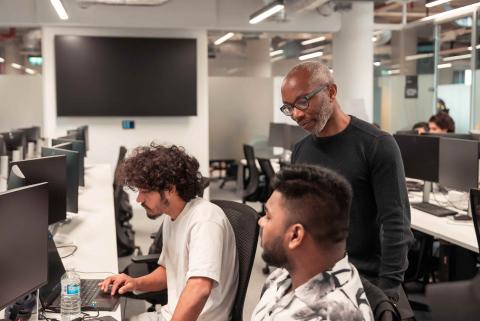
As judges, Phibian and I watched teams move from excitement to uncertainty to determination. Some adapted instantly. Others froze. A few rose to the challenge in ways that reminded me of the best consultants I’ve worked with in the City. And that’s when it became clear: hackathons don’t just test technical skill — they reveal how people think, communicate, prioritise and perform when the stakes rise.
These are the exact qualities SMEs depend on when they hire cyber professionals.
The strongest teams treated the challenge like a real consulting engagement
The teams that performed best weren’t necessarily the most technical. They were the ones who:
- Read the question properly
- Identified the core problem (alert fatigue, supply‑chain transparency, operational risk)
- Explained their thinking clearly
- Showed their assumptions and decision‑making
- Adapted when the rules changed
- Presented with confidence and clarity
This mirrors real cyber work far more than people realise. In the workplace, you don’t get a perfect brief. You get ambiguity, pressure, shifting priorities and incomplete information. The students who embraced that reality delivered solutions that felt credible, not theoretical.
Agile thinking beats rigid methodology
A common question is whether Agile or Scrum is more important than DevSecOps. In practice, Agile thinking is the foundation and DevSecOps is the application of that thinking to secure software delivery.
For students and SMEs, the most important mindset is simple:
Break the problem down. Prioritise. Iterate. Test. Improve.
That is Agile. That is Scrum. That is DevSecOps. They are not competing ideas — they are layers of the same discipline. At CyberHack, the teams who naturally worked in short cycles — plan, test, refine — produced stronger outcomes than those who tried to build everything at once.
Why SBOM matters – in plain language
Most SMEs don’t know the term SBOM and many students only know it at surface level. A simple way to explain it is:
An SBOM (Software Bill of Materials) is a list of all the components inside a piece of software — like an ingredients list for code.
It helps organisations understand:
- What they’re running
- Which third‑party components they rely on
- Where vulnerabilities may exist
- How to respond quickly when a new threat emerges
In a world of supply‑chain attacks, SBOMs are becoming as essential as patching. At CyberHack, the teams who understood the importance of transparency — even if they didn’t use the term SBOM — produced solutions that aligned with modern security expectations.
Pressure reveals potential – and professionalism
We stopped teams early. We changed the rules. We limited presentations to four minutes. Some students were surprised. But this is exactly what happens in real cyber roles:
- A client changes scope
- A regulator asks for evidence
- A board member wants a summary in 60 seconds
- An incident forces immediate reprioritisation
The students who stayed calm, adjusted quickly and communicated clearly showed the qualities that hiring managers look for — far more than perfect slides or perfect code.
Be ready, always
When I worked six days a week in the City, my boss used to say:
“Opportunity doesn’t announce itself. You must already be ready.”
That mindset separates good candidates from exceptional ones. At CyberHack, I saw students who were ready:
- They dressed professionally
- They spoke with confidence
- They treated the challenge seriously
- They showcased their work on LinkedIn
- They asked for feedback
- They acted like future consultants, not just students
These are the people who will stand out in interviews, in client meetings and in the industry.
A message to universities, SMEs and future talent
To universities
Hackathons are not extracurricular activities — they are workforce development. They reveal the skills gap more clearly than any exam. Ref: hackathon.guide
To SMEs
If you want to understand the future of cyber talent, attend a hackathon. You will see problem‑solving, communication and adaptability in their rawest form.
To students
Your degree gets you into the room. Your projects, your thinking, your communication and your readiness get you hired.
Show your work. Publish your projects. Tell your story. Be visible. Be ready.
Conclusion: CyberHack 2026 showed us the future – and it’s full of potential
CyberHack 2026 wasn’t just a competition. It was a reminder that the next generation is capable, creative and hungry to learn — but they need guidance, real‑world context and opportunities to practise under pressure.
At Lockdown Market, we believe in bridging the gap between education and industry. Events like CyberHack show exactly why that matters.
And to the students who competed: You impressed us. Now take that momentum and build something remarkable.
- Log in to post comments
Comments